
Boxing Gloves vs MMA Gloves — Which One Do You Actually Need?


The Question Every New Fighter Gets Wrong
Walk into any gym and you’ll find fighters using the wrong gloves for their training. Boxers buying thin MMA gloves because they look cool. MMA beginners buying massive 16 oz boxing gloves because they seem more protective.
Getting this wrong costs you money, slows your progress, and increases your injury risk.
This guide gives you the clearest, most complete comparison of boxing gloves vs MMA gloves available — so you buy the right pair the first time.
The Fundamental Difference in One Sentence
Boxing gloves are designed for one thing: punching. MMA gloves are designed for two things: punching AND grappling.
That single difference in purpose explains every other difference in design, weight, padding, and finger coverage between the two gloves.
Side-by-Side Comparison
| Feature | Boxing Gloves | MMA Gloves |
|---|---|---|
| Finger design | Fully enclosed (mitten-style) | Open fingers exposed |
| Weight | 8 oz – 16 oz | 4 oz – 7 oz |
| Padding | Thick, multi-layer (entire hand) | Thin, knuckle-focused only |
| Wrist support | High — wide cuff, strong strap | Low — short cuff for mobility |
| Grappling ability | None — fingers locked together | Full — fingers free to grip |
| Striking power | Distributed & cushioned | More impact felt by both fighters |
| Closure | Velcro or lace-up | Velcro only |
| Best for | Bag work, sparring, boxing training | MMA training, grappling + striking |
| Competition use | 8–10 oz in fights, 16 oz sparring | 4 oz UFC/MMA competition |
Boxing Gloves — Everything You Need to Know
What Makes a Boxing Glove a Boxing Glove
Boxing gloves are built around one core principle: maximum protection for a sport that involves nothing but punching. Because boxers throw hundreds of punches per round, often for 10–12 rounds, every part of the glove is engineered to absorb and distribute that impact.
Full hand enclosure: All fingers sit together inside the glove, like a mitten. This design maximizes knuckle padding surface and provides a unified striking platform. It also means zero grappling ability — you physically cannot grab or grip anything while wearing boxing gloves.
Heavy padding: Boxing gloves use multi-layer foam, sometimes combined with gel, to protect both the puncher’s hands and the receiver’s face. This is why heavier boxing gloves (14–16 oz) are mandatory for sparring in most gyms — the extra padding reduces cuts and concussive impact on training partners.
Strong wrist support: The wide cuff and firm strap lock the wrist in proper alignment during strikes. This prevents the small sprains and ligament strains that come from throwing thousands of punches with a slightly bent wrist.
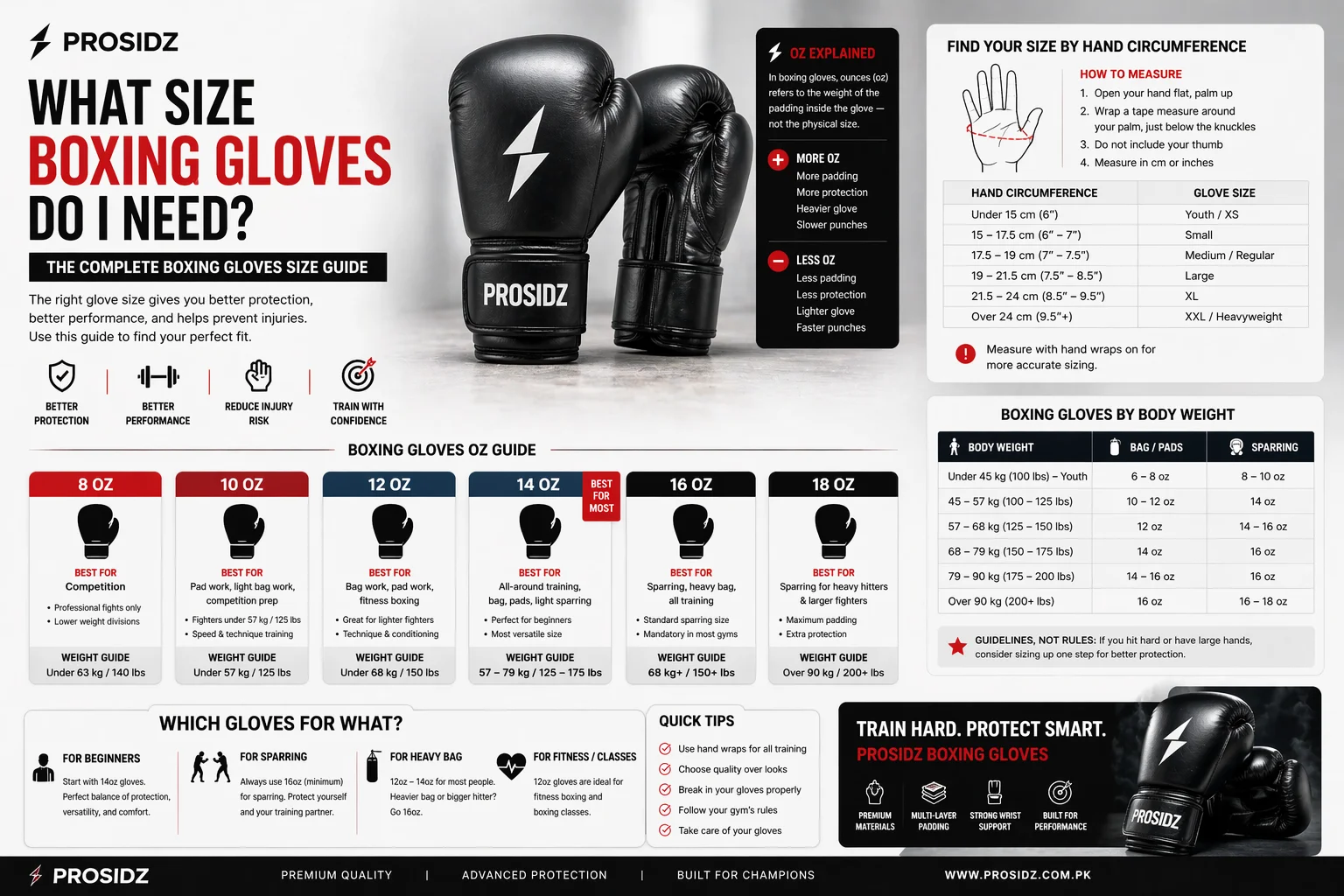
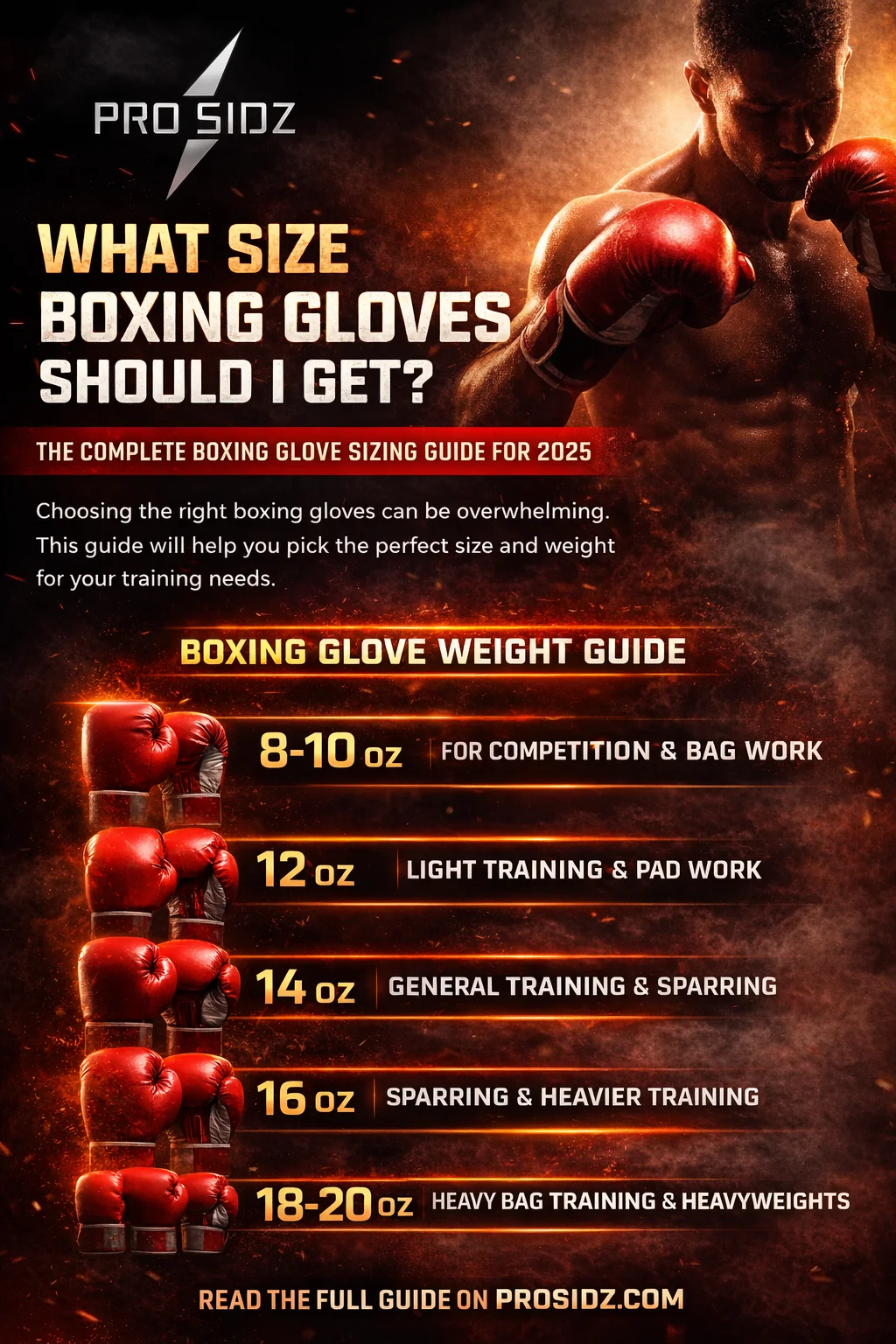
Boxing Glove Weight Guide
| Weight | Best Use |
|---|---|
| 8 – 10 oz | Competition fights |
| 12 oz | Bag work, pad work (lighter fighters) |
| 14 oz | All-around training (most fighters) |
| 16 oz | Sparring — required at most gyms |
Who Should Use Boxing Gloves
- Pure boxers at any level
- Muay Thai practitioners (striking only)
- Fitness boxers and people doing boxing classes
- Anyone whose training is 80%+ striking with no grappling
- Beginners learning punching technique on a bag or pads
MMA Gloves — Everything You Need to Know
What Makes an MMA Glove an MMA Glove
MMA gloves solve a problem boxing gloves cannot: how do you protect a fighter’s hands when they need to punch, grab, clinch, take someone down, and apply submission holds — all in the same fight?
The answer is an open-finger design with targeted padding.
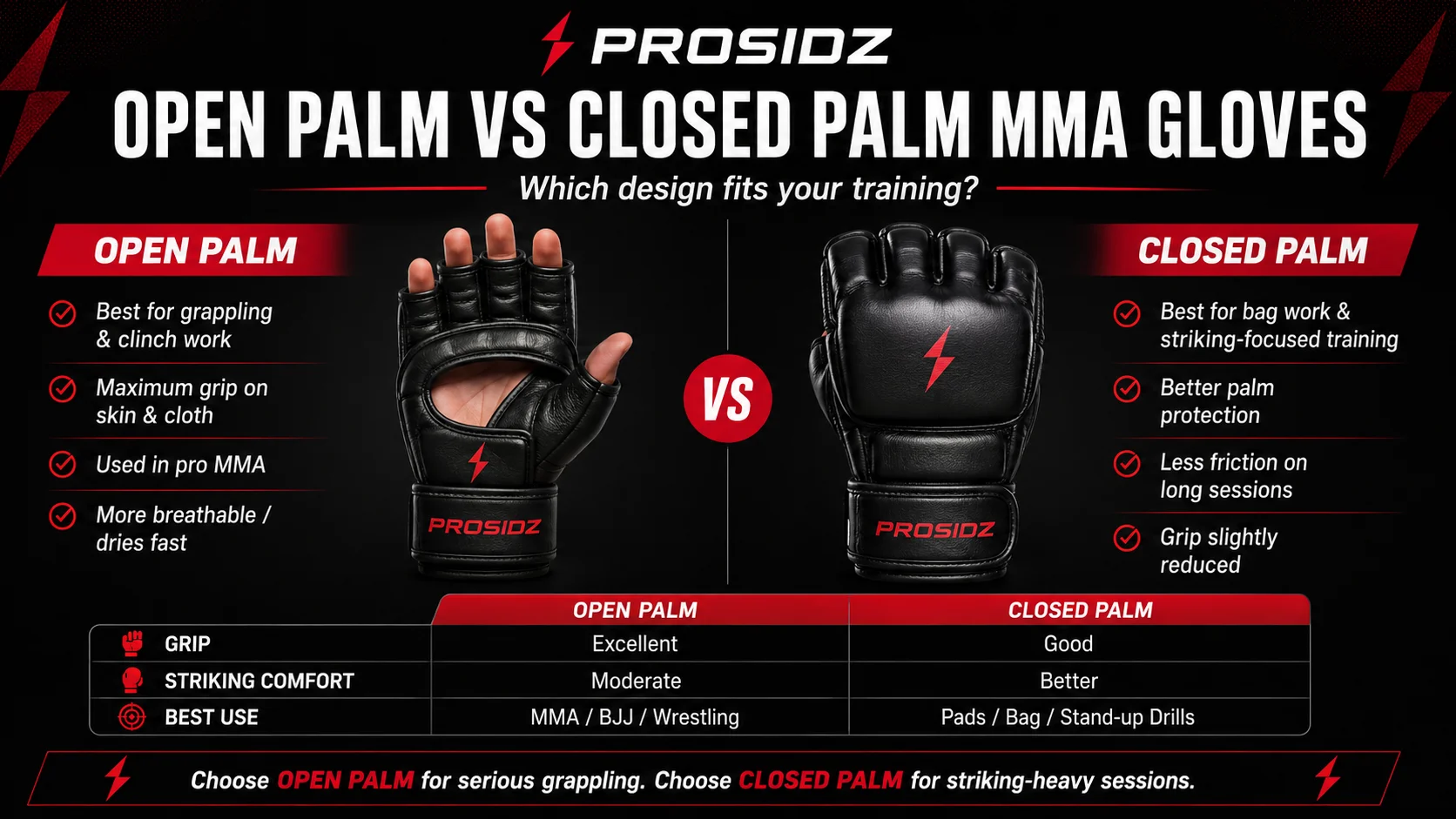
Open fingers: The fingers from the second knuckle are exposed, giving fighters the dexterity to grip, grapple, and apply submissions. This is the defining feature of every MMA glove. Without it, clinches, takedowns, and ground fighting become nearly impossible.
Targeted knuckle padding: Because MMA gloves can’t wrap the entire hand without blocking finger movement, the padding focuses on the knuckles and the back of the hand. This protects against striking impact while keeping the palm and fingers free.
Short wrist cuff: MMA gloves have a shorter cuff than boxing gloves. This allows wrist mobility for grappling maneuvers like clinches, underhooks, and mat work — movements where a rigid boxing-style wrist strap would be restrictive and uncomfortable.
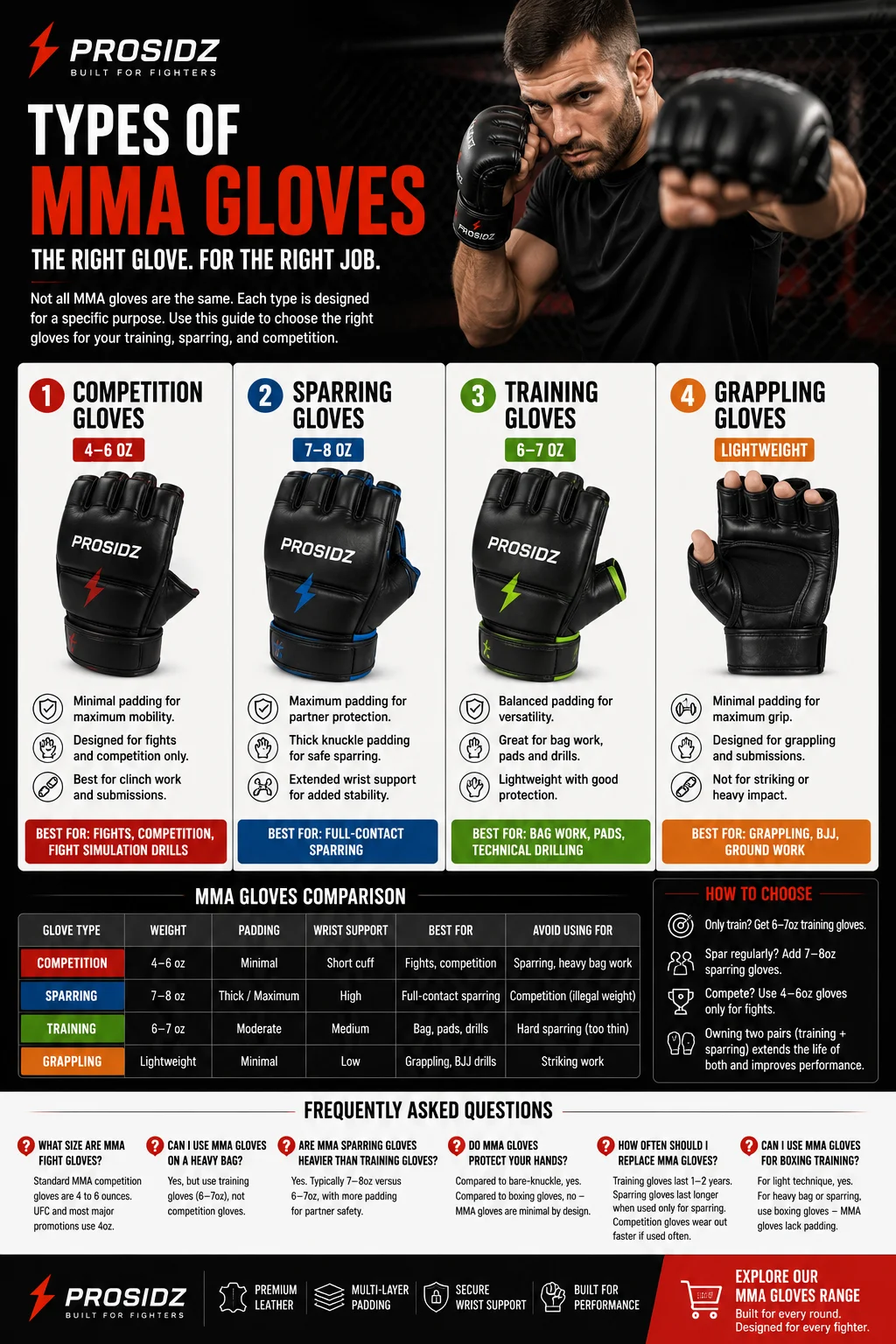
Lighter weight: MMA competition gloves are 4–6 oz. MMA sparring gloves are 7 oz. This lightweight design lets fighters move faster, strike more precisely, and transition between striking and grappling without the bulk of a boxing glove getting in the way.
MMA Glove Types
| Type | Weight | Best Use |
|---|---|---|
| Competition MMA gloves | 4 oz | UFC/MMA fights only |
| MMA sparring gloves | 7 oz | Partner sparring in training |
| MMA training gloves | 5–7 oz | Bag work, pad work, drills |
| Hybrid MMA gloves | 7–10 oz | Cross-training between boxing and MMA |
Who Should Use MMA Gloves
- MMA fighters and grapplers who also strike
- BJJ and wrestling practitioners adding striking to their game
- Fighters who cross-train between disciplines
- Combat sports beginners who want to try both boxing and grappling
- Muay Thai athletes who also train clinch and grappling
The 5 Key Differences Explained
1. Padding — More Is Not Always Better
Boxing gloves win on total padding volume. The multi-layer foam wraps the entire hand and provides superior protection for bag work and sparring in a striking-only context.
But MMA gloves are not “less safe” — they’re differently safe. The targeted knuckle padding is appropriate for a sport where grappling is constant and thick gloves would make ground work almost impossible.
Bottom line: If you’re hitting a heavy bag hard and often, boxing gloves protect your hands better. For mixed training involving grappling, MMA gloves are the correct tool.
2. Finger Design — The Game-Changing Difference
This is the most obvious and most important structural difference. Boxing gloves lock all your fingers together — great for punching, impossible for grabbing. MMA gloves expose your fingers — essential for grappling, less padding overall.
You cannot effectively do MMA training in boxing gloves. You cannot effectively do boxing training in MMA gloves (the thin padding will not protect your hands through heavy bag sessions).
3. Wrist Support — Boxing Gloves Win Clearly
The wide cuff and firm velcro or lace strap on boxing gloves provides significantly better wrist stabilization. This matters especially for beginners whose punching technique isn’t yet consistent.
MMA gloves have a shorter cuff and less rigid strap to allow wrist movement for grappling. This is a necessary tradeoff, not a design flaw — but it does mean MMA gloves offer less wrist protection when striking.
4. Weight and Speed
MMA gloves are much lighter (4–7 oz vs 8–16 oz for boxing gloves). This makes MMA gloves faster on the striking end, but it also means less cushioning between your fist and whatever you’re hitting.
The extra weight of boxing gloves also serves a conditioning purpose — training with heavier gloves builds shoulder and arm endurance that translates to power and stamina in competition.
5. Versatility
MMA gloves allow more types of movement but protect less during pure striking. Boxing gloves protect better during striking but restrict all other hand movements.
Neither glove is universally better — they’re purpose-built for different sports.
Can You Use Boxing Gloves for MMA Training?
Technically yes, but practically no — and here’s why.
Boxing gloves will not allow you to practice any grappling technique. Clinches, takedowns, submissions, and ground-and-pound all require free fingers. Trying to do these movements in boxing gloves will feel completely unnatural and teaches poor technique.
Additionally, if you’re sparring in an MMA context, boxing gloves are bulkier than your partner expects and can actually create safety issues during ground work.
Use boxing gloves for: Dedicated striking sessions, heavy bag training, pad work — separately from grappling. Use MMA gloves for: Combined striking and grappling sessions, MMA sparring, drilling transitions.
Can You Use MMA Gloves for Boxing Training?
This is where many beginners make a costly mistake. MMA gloves (4–7 oz) do not have enough padding for heavy bag work or boxing sparring.
Repeatedly hitting a heavy bag with 4–6 oz MMA gloves will cause hand soreness and potential injury much faster than proper boxing gloves. The knuckle padding compresses quickly under high-volume striking and offers very little wrist support.
For boxing-specific bag work: Always use proper boxing gloves (12–16 oz depending on your weight and purpose). The only exception: Very light technical pad work or drill sessions where contact is controlled.
What If You Train Both Boxing and MMA?
This is the most common scenario for fighters in 2026 — and the answer is simple: you need both.
One pair of boxing gloves (14–16 oz) for striking sessions, bag work, and sparring. One pair of MMA gloves (7 oz sparring gloves) for combined training, drilling, and MMA sparring.
Yes, this is two purchases. But trying to use one glove type for everything will either limit your technique, increase injury risk, or both. Think of it like shoes — you wouldn’t wear running shoes to play football.
Budget strategy for cross-trainers
If budget is tight initially, prioritise boxing gloves first if you’re spending more time striking. Add MMA gloves once your training schedule becomes more mixed. A quality set of both costs less than one physio appointment for a preventable hand injury.
What About Hybrid Gloves?
Hybrid gloves sit between boxing and MMA gloves in design — more padding than MMA gloves, more finger freedom than boxing gloves. Brands like Hayabusa and Fairtex make them specifically for athletes who cross-train.
Hybrids are good for: Casual cross-training, fitness classes that mix boxing and grappling, beginners exploring multiple combat sports.
Hybrids are not good for: Serious bag work (not enough padding), serious MMA sparring (too bulky), competition in either sport.
They’re a useful addition to a collection — not a replacement for proper boxing or MMA gloves.
Quick Decision Guide — Which Glove Do You Need?
Choose boxing gloves if:
- You train boxing, Muay Thai, or kickboxing
- You do heavy bag or pad work regularly
- You spar in a striking-only context
- You’re a beginner learning to punch
Choose MMA gloves if:
- You train MMA, BJJ, or wrestling + striking
- Your sessions mix grappling and punching
- You do MMA sparring
- You compete or plan to compete in MMA
Choose both if:
- You seriously cross-train in boxing AND MMA
- Your gym does both striking and grappling sessions
- You’re building a complete combat sports kit
Shop Boxing & MMA Gloves at Prosidz.com
At Prosidz we carry a full range of both boxing gloves and MMA gloves — built for real training, not just looking good on a shelf.
👉 Shop Boxing Gloves → 👉 Shop MMA Gloves → 👉 Shop MMA Sparring Gloves → 👉 View Full Gloves Collection →
Frequently Asked Questions
What is the main difference between boxing gloves and MMA gloves? Boxing gloves fully enclose all fingers in thick padding, designed purely for striking. MMA gloves have an open-finger design with less padding, built to allow both striking and grappling in the same training session or fight.
Can I use MMA gloves on a heavy bag? It’s not recommended. MMA gloves (4–7 oz) have very little padding for heavy bag work. Regular high-volume striking with MMA gloves can lead to hand soreness and injury. Use proper boxing gloves (12–16 oz) for bag training.
Can I use boxing gloves for MMA sparring? No. Boxing gloves prevent grappling, takedowns, and submissions because all fingers are locked together inside the glove. MMA sparring requires open-finger gloves to practice the full range of techniques.
Which gloves are safer for sparring? For boxing sparring, 16 oz boxing gloves are safest — more padding reduces impact on your partner. For MMA sparring, 7 oz MMA sparring gloves provide more protection than 4 oz competition gloves.
Do I need both boxing gloves and MMA gloves? If you train seriously in both sports, yes. Using the wrong glove type limits your technique development and increases injury risk. If you only train one discipline, buy the glove designed for that sport.
What oz are MMA gloves? MMA competition gloves are 4 oz. MMA sparring gloves are 7 oz. MMA training gloves range from 5–7 oz. These are significantly lighter than boxing gloves, which range from 8–16 oz.
Last updated: April 2026 | Written by the Prosidz gear team