
How Long Do Boxing Gloves Last? Lifespan and Replacement Signs

Your boxing gloves are wearing down right now — every punch compresses the foam a little more, every dripping session deposits a little more salt into the lining, and one day they’ll be done. Knowing when to replace your gloves isn’t just about looking sharp at the gym. Worn-out gloves stop protecting your hands properly, and pushing past that point is how nagging knuckle and wrist injuries start. This guide covers realistic lifespan expectations, six concrete signs your gloves are due for replacement, and the care habits that will genuinely extend their life.
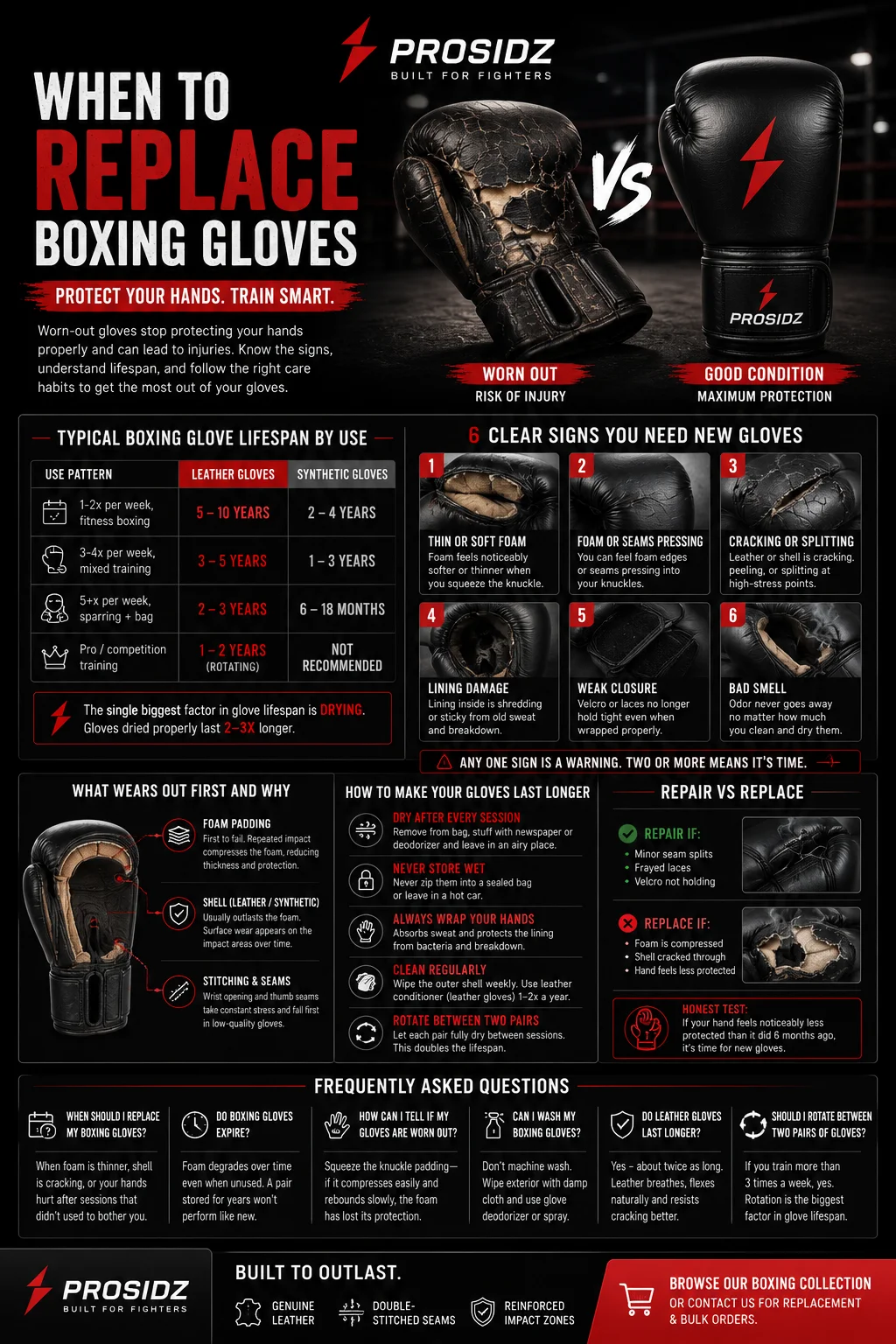
Typical Boxing Glove Lifespan by Use
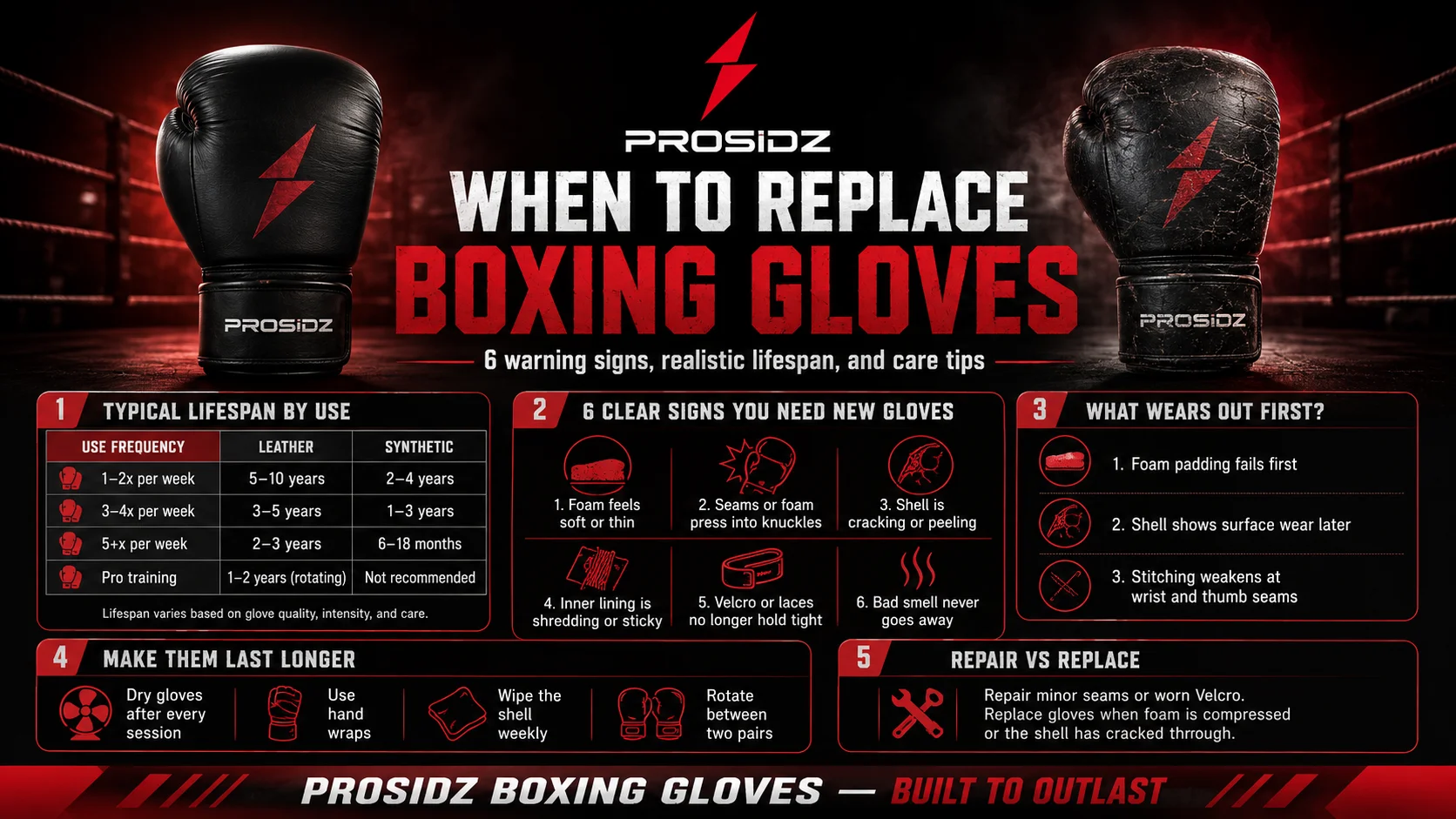
How long your gloves last depends almost entirely on how often you train and what you do in those sessions. A quality leather pair used twice a week for general fitness boxing will easily last five years or more. The same pair used five times a week for hard bag work and sparring is closer to two or three years before the foam starts to thin out. Synthetic gloves are roughly half as durable across the board. The single biggest factor isn’t actually the brand — it’s drying. Gloves that get dried out properly between sessions last two to three times longer than gloves stuffed wet into a gym bag.
| Use Pattern | Leather Lifespan | Synthetic Lifespan |
|---|---|---|
| 1-2x per week, fitness boxing | 5-10 years | 2-4 years |
| 3-4x per week, mixed training | 3-5 years | 1-3 years |
| 5+x per week, sparring + bag | 2-3 years | 6-18 months |
| Pro/competition training | 1-2 years (rotating) | Not recommended |
Six Clear Signs You Need New Gloves
First, the foam feels noticeably softer or thinner when you squeeze the knuckle — this is the most important sign because it directly affects hand protection. Second, you can feel the foam edges or seams pressing into your knuckles during impact. Third, the leather or shell is cracking, peeling, or splitting at high-stress points like the thumb crease or wrist opening. Fourth, the lining inside is shredding or has gone permanently sticky from old sweat. Fifth, the closure (Velcro or laces) no longer holds tight even when wrapped properly. Sixth — and most underrated — the smell never goes away no matter how aggressively you clean and dry them. Any one of these is a signal; two or more means it’s definitely time.
What Wears Out First and Why
Foam padding is almost always the first component to fail, particularly in high-impact zones around the index and middle knuckles. The foam compresses with every punch, and over thousands of impacts it loses its rebound and protective thickness. The shell (leather or synthetic) usually outlasts the foam in modern gloves, though you’ll see surface wear on the impact face. Stitching is the third weak point — the wrist opening and thumb seams take constant flex stress and tend to fail in budget gloves first. Quality gloves use double or even triple stitching on these high-stress seams to push the lifespan out significantly.
How to Make Your Gloves Last Longer
The single most effective habit is drying your gloves out after every session. Pull them out of your bag the moment you get home, stuff them with newspaper or a glove deodorizer to absorb moisture, and leave them somewhere with airflow. Never zip them into a sealed bag overnight. Wrap your hands every session — this absorbs sweat before it reaches the inner lining and dramatically reduces bacterial breakdown. Wipe the outer shell down weekly with a slightly damp cloth, and treat leather gloves with leather conditioner once or twice a year. Rotate between two pairs if you train hard — letting one pair fully dry while you use the other doubles the effective lifespan of both.
When to Repair vs Replace
Minor seam splits, frayed laces, and Velcro that’s lost its bite can all be fixed cheaply if the rest of the glove is sound. A good cobbler can re-stitch a wrist seam for less than the price of a coffee, and Velcro can be replaced. But once the foam padding has compressed or the shell has cracked through to the foam, the glove is done — these aren’t repairs that make economic sense. The honest test is this: if your hand feels noticeably less protected than it did six months ago, replace the glove. Your knuckles and wrists are not negotiable.
Frequently Asked Questions
When should I replace my boxing gloves?
When the foam feels noticeably thinner, the shell is cracking through, or your hands hurt after sessions that didn’t used to bother them. Any one of those is a clear signal.
Do boxing gloves expire?
Not in a date-stamp sense, but the foam degrades over time even when unused. A pair stored for ten years won’t perform like a new pair, even if it looks fine.
How can I tell if my gloves are worn out?
Squeeze the knuckle padding — if it compresses easily and rebounds slowly, the foam has lost its protection. That’s the clearest sign.
Can I wash my boxing gloves?
Don’t put them in a washing machine. Wipe the exterior with a damp cloth and use a glove-specific deodorizer or anti-bacterial spray inside.
Do leather gloves last longer than synthetic?
Yes — typically about twice as long. Leather breathes, flexes naturally with your hand, and resists cracking better than synthetic shells.
Should I rotate between two pairs of gloves?
If you train more than three times a week, yes. Rotation lets each pair fully dry between sessions, which is the single biggest factor in glove lifespan.
Prosidz boxing gloves are built to outlast — genuine leather, double-stitched seams, and reinforced impact zones designed for years of training. Browse our boxing collection or contact our team for replacement and bulk orders.