MMA Sparring Gloves vs Training Gloves: Spot the Differences

Two MMA gloves on a shelf, both around 7 ounces, both with open palms and curved hand shapes. They look almost the same — but one is engineered to absorb sparring impact safely on a partner’s head, and the other is engineered to give you crisp feedback on the heavy bag. Mix them up and you either pulp your training partner or wear out your gloves twice as fast. The differences are subtle on the outside and significant on the inside. Here’s how to tell them apart and when to use each.
What MMA Sparring Gloves Do Differently
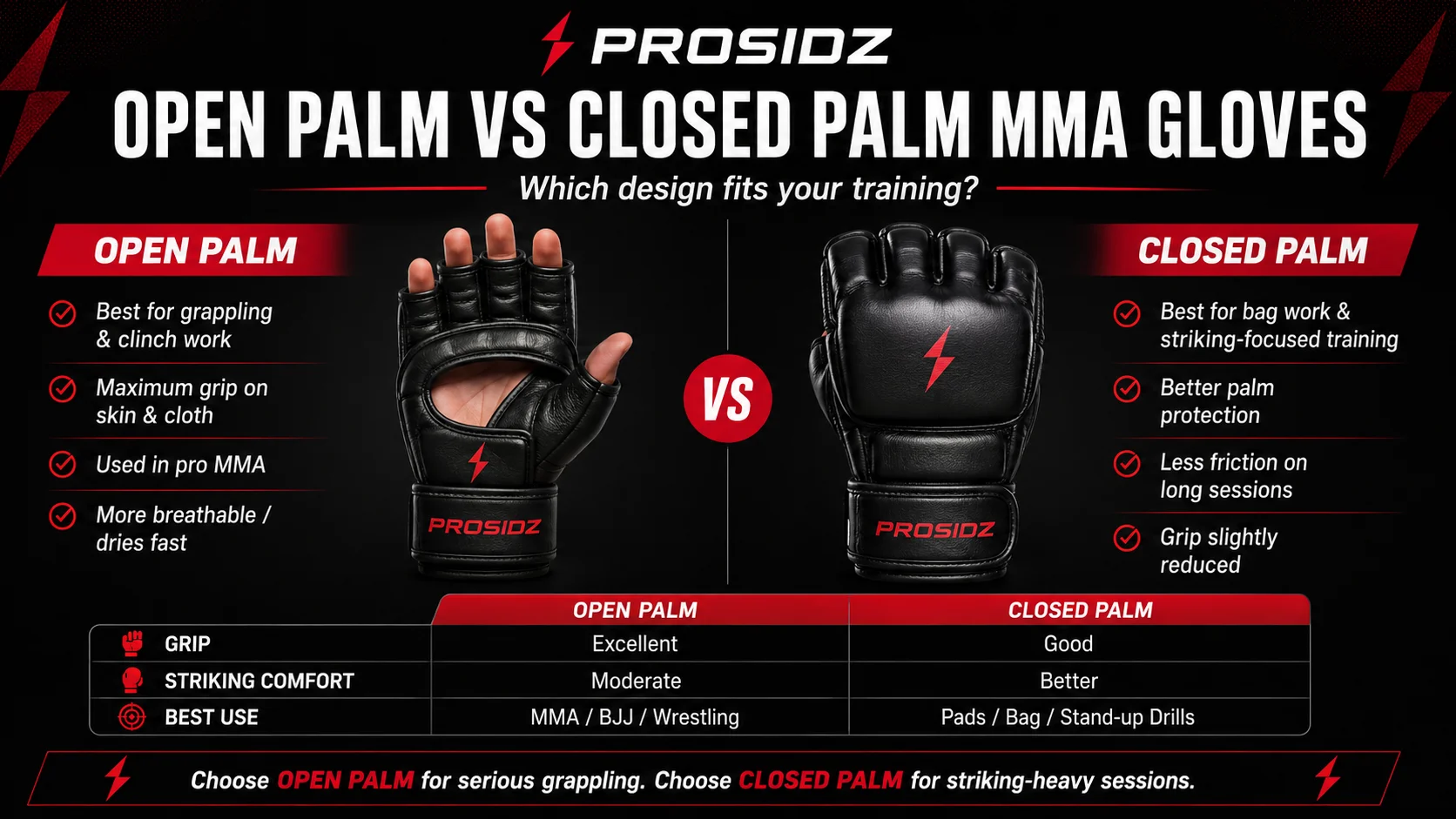
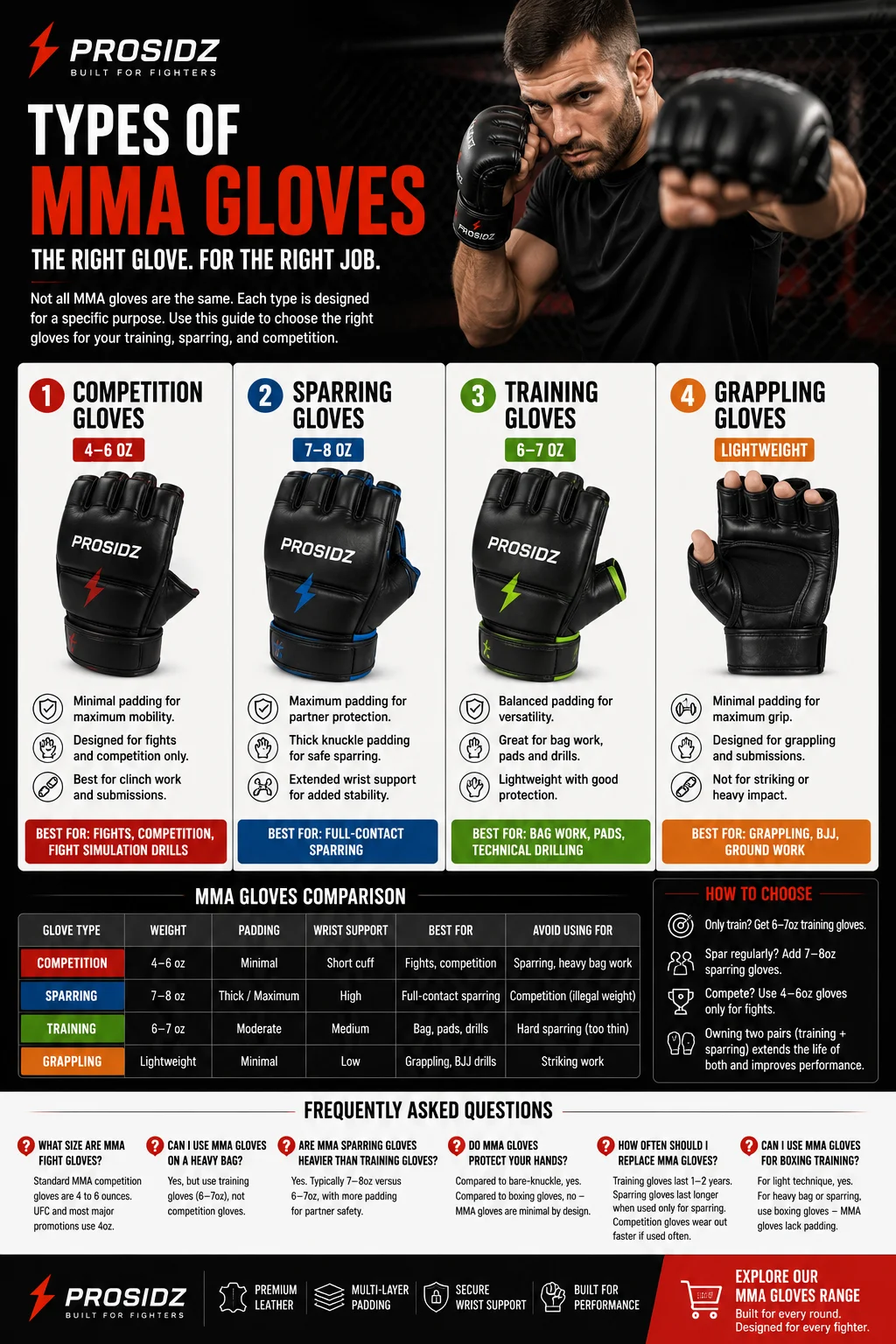
MMA sparring gloves prioritize one thing: protecting the partner you’re hitting. The padding is thicker and softer over the knuckle face, designed to compress and disperse force on impact rather than transmit it directly. The total weight typically runs 7-8oz versus the 6-7oz of training gloves, with most of that extra weight added as foam over the striking face. Many quality sparring gloves also include a slightly curved hand shape that encourages a fully clenched fist, which is safer than a loose fist for both you and your partner during stand-up exchanges. The cuff support also tends to be more pronounced for the wrist torque of full sparring.
What MMA Training Gloves Do Differently
Training gloves balance hand protection with feedback. The padding is firmer and more compact than sparring gloves, which gives you cleaner feedback on the bag and pads — you can actually feel whether you connected solidly or glanced off. The padding is also distributed more evenly across the hand rather than concentrated on the striking face. This makes training gloves more versatile for the full range of MMA drilling: bag work, pad rounds, takedown drills, and light technical sparring where partners aren’t throwing full power. They’re not safe for full-contact sparring, but they’re better for everything else.
| Feature | Sparring Gloves | Training Gloves |
|---|---|---|
| Weight | 7-8oz | 6-7oz |
| Padding | Soft, compressive, partner-focused | Firm, compact, feedback-focused |
| Best For | Full-contact sparring | Bag, pads, drilling, light sparring |
| Wrist Support | Stronger, longer cuff | Standard cuff |
| Hand Shape | Pre-curved, fist-encouraging | More neutral |
| Lifespan With Right Use | Long | Long |
| Lifespan With Wrong Use | Short on bags | Dangerous for partners |
Why You Shouldn’t Mix Them Up
Sparring with training gloves is genuinely risky — the firmer foam transmits more shock to your partner’s head, which is exactly what sparring gloves are designed to prevent. Coaches at serious MMA gyms will not allow training gloves in sparring rounds, and rightly so. Going the other direction is less dangerous but more expensive: using sparring gloves for daily bag work compresses the soft foam much faster than designed, and your sparring pair will lose its protective spec in months instead of years. The financial logic alone makes owning both worth it; the safety logic makes it non-negotiable if you spar.
When One Glove Is Enough
Not every MMA practitioner needs both. If you don’t spar — many people train MMA for fitness or technical development without ever doing full-contact partner work — a quality training glove covers everything you need. If you spar occasionally and lightly, you might still be fine with a single training glove and just dialing back partner intensity to match. The moment you commit to regular full-contact sparring, the calculation changes and a dedicated sparring pair becomes essential. The breakpoint is usually “do I spar harder than 50% power against a real partner more than once a month?” If yes, get the second pair.
How to Tell Them Apart When Shopping
Manufacturers don’t always label clearly, so check three things on the product description: total weight (7-8oz signals sparring, 6-7oz signals training), padding description (“thick,” “protective,” “impact-absorbing” all suggest sparring; “compact,” “responsive,” “feedback” suggest training), and intended use (most quality brands actually state “for sparring” or “for training and bag work” clearly). When in doubt, contact the manufacturer directly. The wrong glove for the wrong job is a far more expensive mistake than asking one extra question before purchase.
Frequently Asked Questions
Are MMA sparring gloves heavier than training gloves?
Yes — typically 7-8oz for sparring versus 6-7oz for training. The extra weight is mostly padding over the striking face.
Can I spar with MMA training gloves?
Not for full-contact sparring. The padding is too firm and transmits too much shock to your partner. Use dedicated sparring gloves.
Do I need both training and sparring gloves for MMA?
If you spar regularly, yes. If you only do bag, pads, and drilling, a quality training glove covers everything.
What are 7oz MMA gloves used for?
Seven-ounce gloves sit at the boundary between training and sparring. Lighter padding makes them training gloves; thicker, softer padding makes them sparring gloves.
How long do MMA sparring gloves last?
Reserved for sparring only, quality sparring gloves last 12 to 24 months of regular use. Used on bags too, expect significantly less.
Can beginners use sparring gloves on the bag?
Technically yes, but the soft padding wears out fast. Better to use training gloves for bag work even as a beginner.
Prosidz produces dedicated MMA sparring and training gloves — separate padding systems for separate jobs. Explore our MMA range or contact our team for gym pricing.