
Lace-Up vs Velcro Boxing Gloves: Which Closure Wins?


Walk into any boxing gym in Sialkot, London, or Las Vegas and you’ll see the same split: half the lockers have lace-up gloves, the other half have velcro. It’s not a random preference. The closure on a boxing glove changes how the wrist locks in, how fast you can gear up, and how the glove ages over hundreds of rounds. If you’re spending real money on a pair, this decision matters more than the colour on the cuff.
Here’s the honest breakdown — what each closure does well, where it falls short, and which one fits the way you actually train.
How Lace-Up Boxing Gloves Work
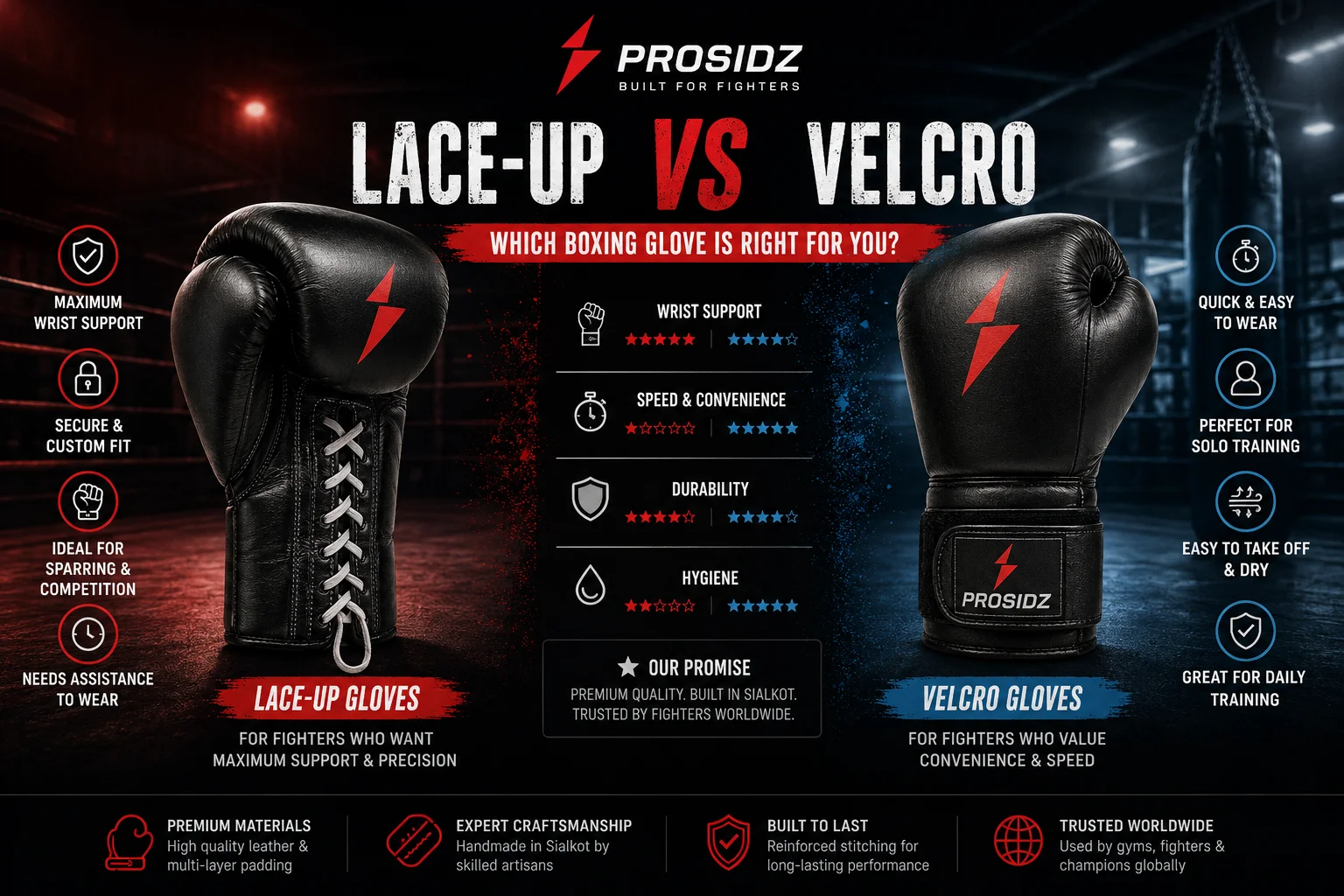
Lace-up gloves use long flat laces threaded through eyelets along the wrist, then tied off and usually taped over. The result is a wrist support system that pulls evenly across the entire forearm cuff, much like a corset. Pros prefer this because the pressure can be customised inch by inch — tight at the joint, slightly looser higher up — and the lock is rock solid for twelve rounds.
The trade-off is obvious: you cannot lace up your own gloves. You need a coach, a corner, or a very patient training partner. That makes them poor for solo bag sessions but excellent for sparring, pad work with a coach, and competition.
How Velcro (Hook-and-Loop) Boxing Gloves Work
Velcro gloves use a wide hook-and-loop strap that wraps around the wrist and locks. Modern hook-and-loop systems on quality gloves are much stronger than the cheap velcro from a decade ago — wide cuffs, double-pass straps, and reinforced anchor points hold the wrist firmly through hard punching.
The upside is independence. You strap up in five seconds, you train alone, you’re done. The downside is that pressure is concentrated in one band rather than distributed evenly, so absolute wrist lock is slightly less precise than a properly tied lace-up.
Wrist Support: The Real Difference
If wrist support is your top priority — say you’ve had a wrist sprain or you throw heavy hooks against a 100lb bag — lace-ups still have a small edge because they can be tied progressively tighter where you need it. But this assumes someone is doing the lacing properly. A poorly laced glove gives less support than a well-designed velcro cuff.
For the everyday boxer, well-built velcro gloves with a wide wrap-around cuff are within a percent of lace-up performance. The construction quality of the wrist itself — multi-layer foam, reinforced stitching, anchor points — matters more than the closure type.
Speed, Convenience and Hygiene
Velcro wins all three. You can put on velcro gloves while your hands are wrapped, on your own, in seconds. You can take them off the same way to dry them between rounds. Lace-ups eat time both directions and the laces themselves absorb sweat that slowly turns sour over months.
For anyone training three to six days a week without a permanent corner team, this convenience adds up quickly.
Durability Over Years of Training
Lace-ups generally outlast velcro because there is no closure mechanism to fail. The eyelets and laces can be repaired or replaced for years.
Cheap velcro gloves lose grip after eight to twelve months — the hook side wears, the loop side flattens, and the glove ends up loose mid-round. Quality velcro from manufacturers using industrial hook-and-loop will last three to five years of hard use. The closure type matters less than the brand’s standards. Our premium boxing gloves are built with reinforced double-pass velcro precisely for that reason.
Quick Comparison Table
| Feature | Lace-Up Gloves | Velcro Gloves |
|---|---|---|
| Wrist support | Excellent (custom tension) | Very good (uniform tension) |
| Solo training | Difficult | Effortless |
| Speed to gear up | 1–2 minutes with help | 5 seconds alone |
| Best for | Sparring, competition | Bag work, daily training |
| Lifespan with hard use | 4–7 years | 3–5 years (quality builds) |
| Hygiene management | Harder to dry | Easy to dry between sessions |
Which Should You Buy?
The honest answer depends on how you train.
If you train alone or train daily with limited time, choose velcro. If you’re competing, sparring with a dedicated coach, or you want maximum wrist precision, choose lace-up. Many serious boxers own both — velcro for daily bag and pad work, lace-up for sparring and fight nights.
Whatever you choose, prioritise the build quality of the glove itself: multi-layer foam, leather or premium microfiber, double-stitched seams, and proper wrist construction. A great velcro glove beats a cheap lace-up every time. Browse the full combat sports equipment range to compare both styles.
Ready to Train With Real Gear?
Explore the full PROSIDZ boxing range — premium lace-up and velcro gloves built in Sialkot for fighters who train every day.
Frequently Asked Questions
Are lace-up gloves better than velcro for sparring?
Lace-up gloves give a more customised, locked-in wrist fit, which is why most professional sparring sessions use them. But high-quality velcro gloves with reinforced wide cuffs are perfectly safe for sparring and far more practical for daily training.
Can you wear lace-up boxing gloves alone?
Not realistically. You can do a basic loop-and-tuck on your own, but you won’t get the wrist tension that makes lace-ups worth using. They’re built for a coach or partner to tie.
Do velcro boxing gloves come loose mid-round?
Quality velcro gloves with wide double-pass straps stay locked through full sessions. Cheap velcro stretches and weakens within a year — that’s a build-quality problem, not a closure problem.
Which closure lasts longer?
Lace-ups generally last longer because the laces can be replaced. Quality velcro lasts three to five years; budget velcro fails much sooner.
What closure do professional boxers use?
Almost universally lace-up for competition and sparring. For daily training, many pros switch to velcro for convenience.
Does PROSIDZ make both lace-up and velcro gloves?
Yes. PROSIDZ manufactures both styles in 8oz–16oz options for sparring, bag work, and competition. Contact PROSIDZ for bulk orders if you’re outfitting a gym.